Core Comparison: Feedback360 vs. Other Salesforce Survey Tool
Published on June 22, 2026 Feedback360
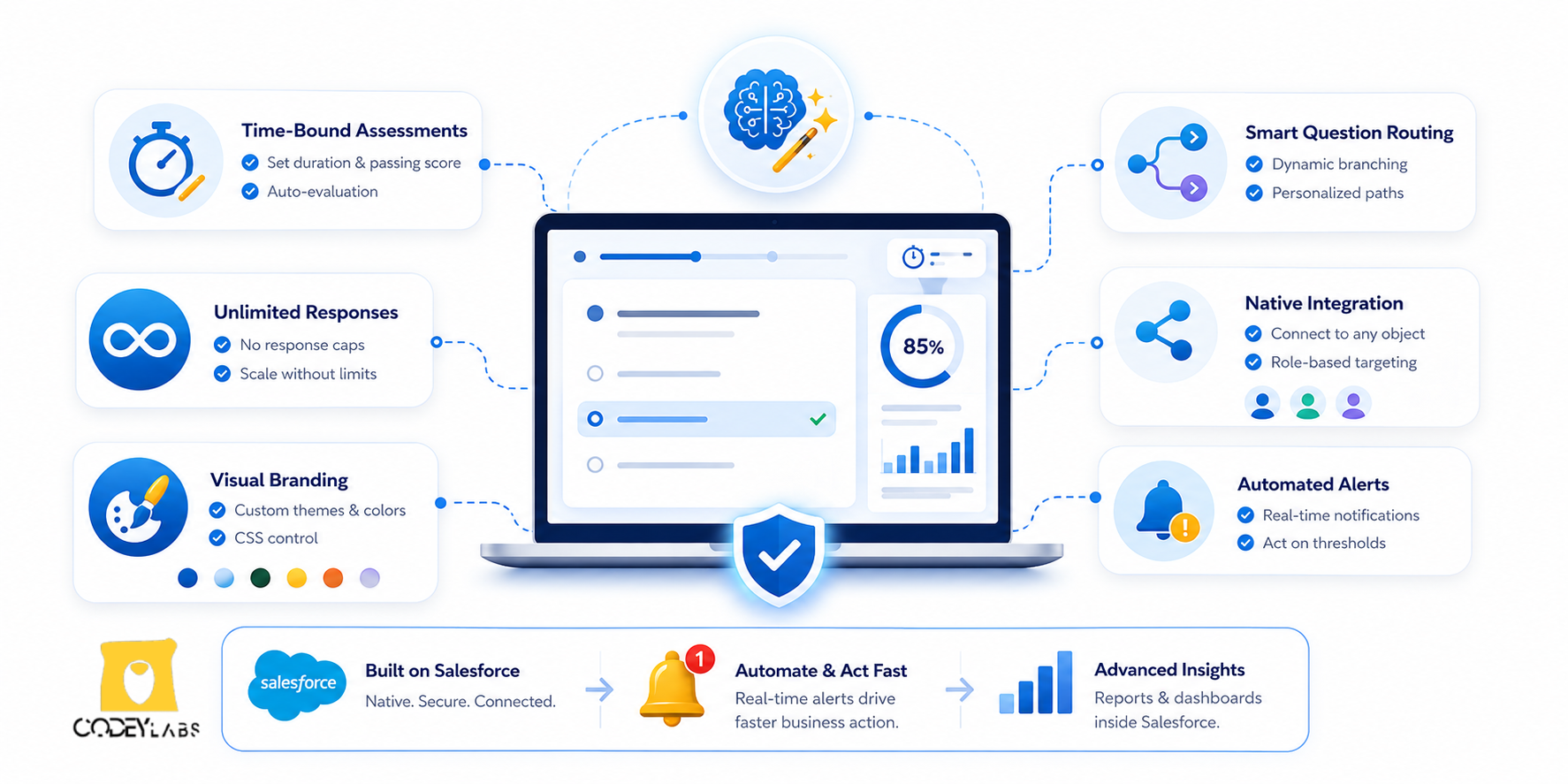
Feedback 360: Competitive Differentiators and Strategic Advantages
While many organizations rely on general-purpose survey platforms for feedback collection, Feedback 360 delivers specialized capabilities that distinguish it from standard survey tools. The following comparison illustrates how Feedback 360's architecture and feature set address enterprise requirements beyond traditional feedback collection.
Feature Comparison: Feedback 360 Capabilities and End-User Benefits
| Feature Category | Feedback 360 Capabilities | End-User Impact |
| Assessment & Testing | Time-bound mock tests with defined durations, minimum passing scores, and automated evaluation. | Enables certification readiness validation and academic assessments with exam-like conditions. |
| Content Creation | Generative AI engine produces fully functional surveys and assessments with questions and options in minutes. | Eliminates manual question drafting and research overhead; accelerates survey deployment. |
| Response Scalability | Supports unlimited survey responses without per-response cost increases typical of external platforms. | Enables cost-effective scaling for large organizations and high-volume survey campaigns. |
| Visual Branding | Extensive customization including themes, background images, color palettes, and CSS control for Experience Sites. | Delivers professional, cohesive brand presentation across all devices and respondent touchpoints. |
| User Experience | Dynamic question routing with conditional branching enabling personalized, adaptive respondent paths. | Improves engagement by delivering only relevant questions to specific respondent segments. |
Five Strategic Advantages of Feedback 360
1. Specialized Assessment and Testing Engine
Unlike general-purpose survey tools designed primarily for basic feedback collection, Feedback 360 functions as a robust assessment engine. The platform enables users to simulate authentic exam conditions through time-bound testing capabilities. The system automatically tracks candidate performance metrics including scores and elapsed time, providing detailed analytics to identify specific skill gaps. This capability makes Feedback 360 particularly valuable for Learning and Development programs, corporate certification initiatives, and educational technology deployments.
2. AI-Powered Content Generation for Rapid Deployment
A significant productivity advantage for professionals and educators is Feedback 360's generative AI-powered content creation engine. End users can generate comprehensive assessments for any subject, class, or topic with a single click, leveraging advanced AI models and public knowledge datasets to produce diverse, relevant questions. This functionality dramatically reduces the time required to develop and deploy testing materials, enabling the creation of "personalized learning" environments far more rapidly than manual survey development processes would allow.
3. Deep Native Integration Without External System Fragmentation
Because Feedback 360 is built entirely on the Salesforce Platform Cloud, the solution eliminates the "jungle of external systems" that characterizes typical enterprise feedback management. The platform provides three critical integration advantages:
Contextual Data Linking: Survey invitations and responses can be directly related to any standard or custom Salesforce object, bridging feedback data seamlessly with core business automation and customer records.
Role-Based Audience Segmentation: Users can effortlessly target surveys to specific groups based on organizational role and responsibility, enabling precise audience management without external tools.
Real-Time Alerting: The system triggers real-time notifications when specific thresholds are met (for example, low satisfaction scores), enabling immediate business response and intervention.
4. Complete Participant Journey Control Through Unified Administration
Feedback 360 provides a unified administration hub that manages all survey elements—questions, participants, and responses—in a single integrated location. This design offers administrators complete visibility and control. The platform supports flexible survey formats, allowing organizations to select between single-page forms for rapid feedback collection or multi-page formats for comprehensive, in-depth assessments. This flexibility enables organizations to tailor survey experiences to respondent attention span and engagement patterns.
5. Enterprise-Grade Reporting Without Data Silos
While external survey platforms require data consolidation from multiple disconnected systems, Feedback 360 leverages native Salesforce reporting and dashboard capabilities. This architecture eliminates data fragmentation and enables end users to generate cross-functional insights directly from the system where customer, employee, and operational data already resides. Organizations benefit from unified reporting on survey responses, response patterns, and performance metrics without manual data export or integration.
Strategic Positioning
Feedback 360 differentiates from traditional survey platforms through its design as a purpose-built assessment engine integrated natively into the Salesforce ecosystem. For organizations evaluating feedback collection platforms, Feedback 360 offers particular advantages when requirements include: time-bound testing and certification validation, rapid assessment creation through AI assistance, seamless integration with existing Salesforce data and processes, support for unlimited response scale, and comprehensive brand customization with minimal external system dependencies.
Knowledge Article Number: KA-00270